
Server Rack Rental and Colocation
Host your own servers in a secure, uninterrupted, high-performance data center. MAV Cloud Colocation / Rack Rental moves businesses’ physical servers into a professional data center environment, delivering high availability, robust internet infrastructure and maximum physical security.
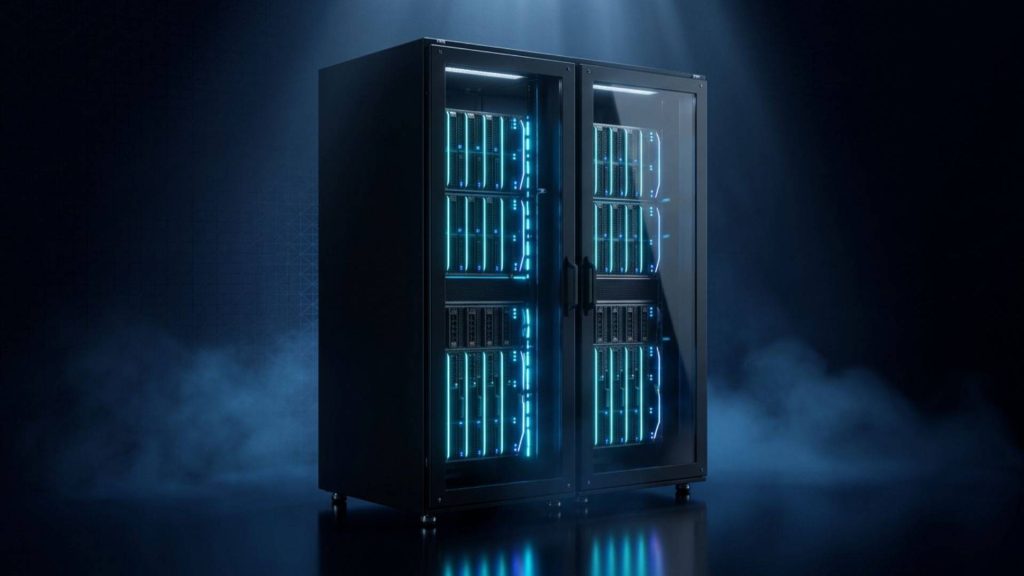
- Equinix Istanbul data center
- VMware-based infrastructure
- Veeam-based backup
- 99.9% availability target
- 15-min critical response target
- ISO 27001 · 22301 · 9001
Our Colocation / Rack Rental service
Your servers run in data centers protected by redundant power systems, UPS and generator infrastructure, advanced climate control, 24/7 physical security and continuous monitoring. This lets you keep using your own hardware while benefiting from all the advantages of enterprise data center standards.
Depending on your needs, we offer 1U, 2U and 4U server hosting, half-rack or full-rack options. With high-speed internet access, 10 Gbps and 25 Gbps network connections, BGP support, dedicated VLANs and redundant uplink options, we build robust infrastructure for your critical systems.
With remote access, Remote Hands, hardware support, cabling, installation, network management and technical operations services, you can easily manage your infrastructure without visiting the data center.
Get a custom quote
Tell us what you need, and our expert team will get back to you as soon as possible.
- Phone+90 532 054 49 14
- Emailinfo@mavcloud.com.tr
Why MAV Cloud Colocation?
- Secure, professional data center infrastructure
- 1U, 2U, 4U, half-rack and full-rack options
- Redundant power (UPS + generator)
- Advanced climate control and fire suppression systems
- 24/7 physical security and CCTV monitoring
- 10 Gbps and 25 Gbps high-speed internet infrastructure
- BGP and custom networking support
- Remote Hands (remote technical assistance) service
- Low-latency, high-availability network architecture
- 24/7 expert technical support
Server colocation in Istanbul: Equinix infrastructure
Server colocation (rack rental) means housing your company’s own servers and network equipment in a rack at a professional data center. MAV Cloud provides server rack and colocation services in Istanbul on Equinix Istanbul data center infrastructure. Your equipment runs in an environment with redundant power, cooling, physical security and multi-carrier connectivity, and your data stays in Türkiye.
The most common goals when moving from an in-office server room to a data center are eliminating the risk of power and cooling outages, improving connectivity and moving hardware to an environment monitored 24/7. For servers placed in the rack, 24/7 System Monitoring and backup services can be combined under the same contract.
Service assurance: Support requests from rack customers are handled according to the priority levels in the service level agreement: first-response targets of 15 minutes for critical situations, 1 hour for serious performance degradation and 4 hours for partial impact. MAV Cloud’s information security and business continuity management systems are ISO/IEC 27001 and ISO 22301 certified (see our certifications).
What determines colocation pricing?
The cost of server rack rental depends on the space and power used in the rack, together with the scope of services. The following details are clarified before a quote:
- Space: a full rack, half rack or space by rack unit (U).
- Power: the total power consumption of the equipment and the need for redundant (A+B) power feeds.
- Connectivity: bandwidth, number of IP addresses and cross-connect requirements.
- Remote hands: on-site tasks such as cabling, disk replacement and reboots.
- Additional services: monitoring, backup, firewall and managed services.
| Rack option | Monthly starting price |
|---|---|
| 1U | From USD 100 |
| Quarter rack | From USD 400 |
| Half rack | From USD 800 |
| Full rack | From USD 1,150 |
Rack prices do not include electricity; power consumption is billed separately. The final price depends on rack type, power requirement and add-on services and is set in the quote.
Your own server room, colocation or cloud?
If you have already invested in hardware and it still has useful life, colocation is the quickest way to move to data center standards while protecting that investment. If a hardware refresh is approaching, Dedicated Server Rental or moving to a cloud server removes the hardware maintenance burden entirely. The topic is covered in detail in our what is colocation guide.
To estimate kW load per rack, U requirement and the circuit type for A + B feeds from your server and device count, use the rack power and space calculator.
Rack colocation options: 1U, quarter, half and full rack
Rack colocation is sold by space: a single rack unit (1U), a quarter rack, a half rack or a full rack. The right size depends on how many devices need to be housed, how much power they draw and how much room is needed for growth.
A rack unit (U) is a standard height of 1.75 inches (44.45 mm). A full rack is commonly 42U, and quarter and half racks divide that space; the exact usable units vary by data center and are confirmed in the quote. As a generic guide:
| Option | What usually fits | Typical use |
|---|---|---|
| 1U | A single 1U server | A web or application server, a VPN gateway, a backup target |
| Quarter rack | A few servers plus a switch and firewall | Small businesses moving an office server room |
| Half rack | Several servers, storage and network devices | Growing infrastructure with virtualization hosts |
| Full rack | A complete stack with redundant network and storage | Corporate core systems, dense or GPU-heavy hardware |
Space is only half of the sizing. Power density often decides the rack type before U count does: a few GPU or high-core servers can need more power than a full rack of lighter devices. Quarter rack colocation is a common starting point because it leaves room for a second server, a switch and a firewall without paying for a full rack. MAV Cloud colocation starts from USD 100 per month for 1U, with electricity billed separately.
How server colocation works, step by step
Server colocation moves company-owned hardware into a data center rack while ownership and administration of the servers stay with the company. The data center provides space, power, cooling, physical security and connectivity. A typical move starts with an inventory of every device, its height in U, power draw and network ports. Power and network design follows: A+B redundant feeds, bandwidth, IP addresses and any cross-connects. A downtime window is then agreed, fresh backups are taken and every cable and disk is labelled. On installation day the hardware is mounted, power and network are cabled and airflow direction is checked. Connectivity, remote management access and services are tested before traffic is switched. After go-live, remote hands handle reboots, cabling and disk swaps on request.
Support requests from rack customers follow the priority levels in the service agreement, with first-response targets of 15 minutes for critical, 1 hour for high, 4 hours for medium and 1 business day for low priority. At MAV Cloud, colocation runs in the Equinix İstanbul data center.
Power, cooling and network in a colocation rack
In most colocation projects power, not space, is the first limit. The power each rack can draw and the redundancy of its feeds shape how densely servers can be packed, and cooling capacity follows the same figure.
Redundant A+B feeds let dual power supply servers keep running if one circuit fails, so devices with a single power supply need a transfer switch or a planned replacement. Because electricity is billed separately from rack rental, measuring real consumption instead of using nameplate values keeps both the circuit choice and the monthly bill realistic. On the network side, the questions are uplink speed (10 Gbps and 25 Gbps options are available), the number of public IP addresses, whether the company brings its own IP space over BGP, and whether cross-connects to carriers or cloud platforms in the same building are needed. Airflow matters too: front-to-back cooled devices mounted in the wrong direction raise inlet temperatures for the whole rack.
To estimate kW per rack, U requirement and A+B circuit type from a device list, use the rack power calculator; the basics are explained in what is colocation.
Who is Colocation / Rack Rental for?
- Businesses that own their server and network hardware
- Companies looking to move their office server room to a professional data center
- Systems that need high bandwidth and uninterrupted power
- Organizations that want to keep control of their hardware
Frequently asked questions about Colocation / Rack Rental
What is colocation (rack rental)?
Colocation means hosting your own server and network devices in racks within a data center. You own the hardware; the data center provides power, cooling, physical security and connectivity infrastructure.
Are there options other than a full rack?
Depending on your needs, per-U, half-rack or full-rack options are available. Talk to our team to determine the right size.
Can I physically access my devices?
Yes, access to your devices is provided in accordance with the data center’s security procedures. With remote hands support, simple interventions can also be carried out on your behalf.
Is rack rental the same as colocation?
In a data center context, yes. Colocation means housing your company’s own servers in a rack at a data center; it is also called server rack rental or rack hosting.
How are existing servers moved to the data center?
Before the move, an inventory and connectivity plan are prepared and a downtime window is scheduled. Service goes live once the equipment is installed in the rack and network connections are tested; our technical team is with you throughout the process.
Related guides
Our other cloud solutions
 Cloud Server RentalGet the processing power, RAM and storage your business needs without the high cost of hardware. MAV Cloud Server Rental delivers high…Learn more
 Dedicated Server RentalChoose our Dedicated Server Rental service for high performance, maximum security and hardware resources that are entirely yours. MAV Cloud provides CPU, RAM and…Learn more
 GPU ServerIf your AI, machine learning, deep learning and high-performance computing projects need powerful GPU infrastructure, MAV Cloud GPU Server Rental…Learn more
 S3 Object StorageStore your data on S3 Object Storage infrastructure that is secure, scalable, and highly available. MAV Cloud S3 Storage provides applications, backup…Learn more
 CCTV CloudWith our CCTV Cloud service, store your security camera recordings on secure cloud infrastructure without depending on physical recording devices. MAV Cloud, camera…Learn more
 Cloud Migration ServicesCloud migration services in Turkey: move physical servers, virtual machines and data to the cloud securely, with careful planning and minimal downtime.Learn more